CATL Accelerates Low-Altitude Ambitions with Double eVTOL Partnership in November
CATL has solidified its position in the emerging low-altitude economy by securing two exclusive battery supply agreements with eVTOL manufacturers within a single month.
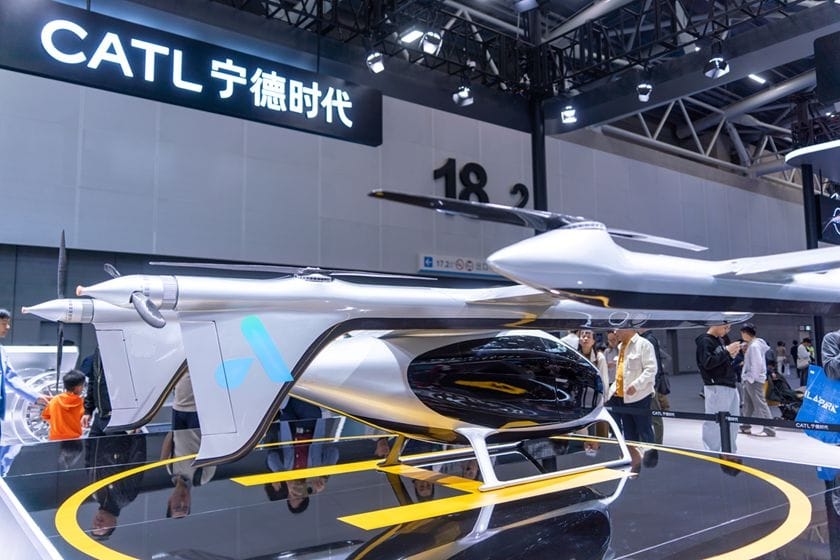
On November 12, 2026, the global battery giant CATL announced an exclusive partnership with EVT Aerotechnics to provide aviation power batteries for its manned and cargo-carrying electric vertical take-off and landing (eVTOL) aircraft. This follows a similar exclusive deal signed on November 2 with Skyla (Shanghai) Aviation Technology, where CATL will develop custom batteries for the company’s Skyla V30 pure electric tilt-rotor eVTOL.
These recent signings expand CATL’s footprint in the sector, marking its third major partnership following an investment of several hundred million USD in AutoFlight in August 2024.
The High Stakes of Aviation Safety
Unlike standard electric vehicle (EV) batteries, aviation power systems require a higher threshold of energy density, power density, and cycle life, alongside stringent safety and reliability standards.
A core requirement for aviation battery safety is preventing the propagation of thermal runaway. According to Mei Ao, CEO of Guangzhou Lingding Energy Technology, while standard automotive battery tests focus on preventing thermal propagation after a single cell is triggered, aviation standards are significantly more rigorous. They require that no thermal propagation occurs even when two adjacent cells are triggered simultaneously.
CATL has already demonstrated progress in this area. In August 2026, the company announced that its aviation battery system for manned eVTOLs passed the "simultaneous thermal runaway of two adjacent cells" test, with the process witnessed by representatives from the Civil Aviation Administration of China (CAAC).
Navigating the Path to Commercialization
Beyond hardware, the path to commercialization involves complex airworthiness certification - a technical review by aviation regulators that is a prerequisite for commercial operation. This necessity is driving battery manufacturers to collaborate with aircraft developers from the earliest stages of R&D.
To further bolster its capabilities, CATL signed an agreement with the Civil Aviation University of China on November 11 to establish a joint laboratory for aviation battery airworthiness. The partnership will focus on developing airworthiness standards, compliance verification methods, and testing platforms.
A Competitive Landscape
The potential of the low-altitude economy has attracted numerous battery players, with Guotai Junan Securities projecting the domestic eVTOL battery market to reach 112.6 billion yuan (~16.8 billion USD) by 2030. Other key players in the space include:
- Sunwoda: Partnered with Anhui Shangfei Aviation Technology in November 2025, including a 20 million yuan (~3.0 million USD) capital injection for a 6.25% stake.
- CALB: Announced the mass production of power battery systems for Xpeng Aeroht’s "Land Aircraft Carrier" in March 2026.
- Gotion High-Tech: Partnered with EHang in June 2025 and launched a dedicated aviation battery product in September 2026.
- Zhejiang Fengli (Ganfeng Lithium): Signed a deal with Aerofugia in February 2026 for airworthiness verification.
While the market potential is vast, the transition from partnerships to sustained, large-scale demand remains contingent on the successful certification, mass production, and commercial operation of these eVTOL models.

